


About the Jewish Lawyer

Jeremy Green Eche is a branding attorney and the founder of JPG Legal and Communer, a marketplace for registered trademarks. He is the attorney of record for over 5,000 U.S. trademark registrations. In 2019, JPG Legal was ranked the #16 law firm in the United States by number of federal trademark applications filed. Eche graduated from Northwestern University School of Law on a full scholarship. Thomson Reuters selected him as a Super Lawyers Rising Star in Intellectual Property for 2021-2026.
Eche has been featured on Business Insider, USA Today, CNBC, CNN Money, NPR's Morning Edition, WIRED, MSNBC, Fox News, Forbes, the New York Daily News, HLN, The Hollywood Reporter, CNN Politics, DCist, ABA Journal, Vox.com, CNET, Mic.com, NBC News, Refinery29, the Globe and Mail, and several other news sources.
Jeremy writes a branding and growth blog called Ask a Jewish Lawyer®, and a mailing list on the same topic with over 5,000 subscribers. Before becoming a trademark attorney, he was known for owning ClintonKaine.com and hosting his comics there during the 2016 election, before selling the domain for $15,000. Then he bought HarrisWalz.com in 2020, "brat-ified" it, and sold it on Communer in 2024, also for $15,000.
Eche is based in Brooklyn in New York City. He formerly served as in-house General Counsel for Teamsters Local 922 in Washington, DC. Eche is married to Stephanie Eche, an artist and creative consultant. He has moderate Tourette syndrome.
You can contact him at info@jpglegal.com.
Clothing Trademarks: Classes and Specimens for Apparel

Clothing trademarks might be the most commonly filed-for trademarks, as well as the most difficult to file correctly. This is mainly because of how complicated the rules are about trademark classes and specimens. In this post, I’ll go over common mistakes to avoid and strategies to use when filing a trademark application for apparel.
Usually if you’re filing for a clothing brand, you’re filing in class 25 (the apparel trademark class), but sometimes you might want to file in class 35 for retail store services. I’ll cover both options in this post.
- Retail Store Services for Clothing (35) vs. Clothing Goods Themselves (25)
- Ornamental Use for Clothing Goods
- Making Clothing as a Service vs. the Clothing Itself as Goods
- Trademark Specimens for Clothing Trademarks
- What Apparel Goods IDs to file for in Class 25 (You Can’t Just Put “Clothing”)
- Yes, That Was a Lot
Retail Store Services for Clothing (35) vs. Clothing Goods Themselves (25)
I file so many different types of trademark specimens that I wrote a guide about it. So it’s significant when I say that the retail-store-services vs. goods-themselves issue is one of the largest headache-causers for me and my associate attorneys. There are many businesses out there that could reach registration for both retail store services in class 35 and for clothing goods in class 25. There are many other businesses that should really only register in one or the other. Who should register for which classes?
A. In general, if you have an online store with your own branding on it, usually on your own website (like a Shopify store), or if you have your own brick-and-mortar store, you can register your brand name in class 35.
B. In general, if you sell clothing with your own branding on the labels or packaging, through the retail services of other companies like Amazon, you should register for your specific clothing goods in class 25.
Clearly, many e-commerce companies fall under both A and B, and may have a difficult choice to make. Importantly, having an Amazon, eBay, Etsy, or Alibaba storefront doesn’t count as having your own retail store, and this kind of specimen will be rejected by the USPTO for any service in class 35.
So if you don’t plan to have your own functioning e-commerce store on your own website, either built from scratch or using an e-commerce website development platform, do not file for retail store services in class 35. File for the goods themselves.
If you are selling goods on your own website using a white label service like Shopify, Squarespace, or WordPress’s Woocommerce, then you can file for retail store services in class 35.
For people who will have their own web stores, but whose products will also have the same branding on them, possibly sold on Amazon in addition to in-house, a tough choice needs to be made. Both choices have benefits and drawbacks. Here is my general advice for which types of goods/services to file for if you can file for either type:
If you sell (or plan to sell) a wide variety of goods, class 35 for retail store services is cheaper than filing for a bunch of goods in multiple classes, because you can fit everything under one class, avoiding the filing fees required for additional classes.
However, filing for retail store services in class 35 is also, in my opinion, riskier than filing for the goods themselves.
Others may disagree with me, but based on my experience, your USPTO examining attorney will be a little more likely to reject your application based on a likelihood of confusion with an existing trademark if you file for retail store services in class 35. They will cast a slightly wider net when looking for similar marks, and will consider more goods and services to be “related” to your goods/services under trademark law. Filing for clothing goods in class 25 is thus a little safer than filing in class 35.
Thus if you have any reason to believe that your brand name is in danger of being rejected for being too similar to another brand name, you should probably just file for clothing goods in class 25. Your USPTO examining attorney will likely view your goods/services IDs as being narrower than if you had filed for retail store services for the exact same goods.
Additionally, you may notice an option that seems like it will essentially let you register your trademark for a retail store for pretty much all goods, called “retail store services for a wide variety of goods of others.” Do not choose this option if you are only selling your own branded goods, and not the goods of other brands.
Notably, Amazon Brand Registry accepts trademarks filed in either class. So while an Amazon store won’t work as a specimen for class 35, a class 35 trademark will qualify you for Amazon Brand Registry. This is good to know if you sell on both your own store and Amazon.
Ornamental Use for Clothing Goods
Another very common pitfall for people is where they are using the mark in relation to their clothing goods. You’re not really supposed to trademark a design or phrase if you’re just using it on the front of t-shirts or hats. This is called “ornamental use,” which essentially means you’re using it on your products to increase their appeal, and not to identify your brand.

Images that you use on merchandise that don’t identify your brand should be registered as copyrights, not trademarks. For example, if you sell 30 different t-shirts, each with a different animal illustration on them, none of those illustrations are trademarks because they’re not the logo of your clothing brand. They’re just “ornamenting” the t-shirts. So you can register each one as a copyright if you want to. Or if you want to save money, you can wait until somebody steals one of the illustrations for their own merchandise, and then register that particular design as a copyright.
Short slogans that you slap on products like “World’s Best Dad” or “Don’t talk to me until I’ve had my third cup of coffee” probably can’t be protected at all. They don’t identify your brand, which means they’re not trademarks, and they’re not really substantial enough to be registered as copyrights. Copyright protection is really meant for full creative works like poems, songs, books, or works of art. A catchy slogan probably doesn’t rise to that level.
Of course, sometimes a slogan or illustration can be a brand identifier, which means it can be registered as a trademark. If Nike had simply put “Just Do It” on the front of a t-shirt, it would have been ornamental use. But Nike also uses “Just Do It” in various ways that make it clear that the phrase is meant to be a brand identifier. In other words, because of certain steps Nike has taken, consumers can identify a product as a Nike product simply by seeing “Just Do It” displayed somewhere on the product. It identifies the Nike brand.
Overcoming — Or Avoiding — an Ornamental Use Refusal
If you really want to register your t-shirt illustration or baseball cap tagline as a trademark, or if you’ve already filed a trademark application for one and you want to salvage your application, there are a few things you can do to establish that you’re actually using the slogan or design as a mark and not just decorating your goods with it. You do not need to do all of the below steps; usually just doing one of them is enough.
- •If you have an Amazon store, make your slogan the name of your Amazon store.
- •If you make clothing or other goods, put the slogan or design in the places where consumers would normally expect brand identifiers to be, in a way that indicates that it’s a brand identifier. For example, instead of covering the front of a shirt with your mark, put a tiny version of your mark on one of the breasts of the shirt (the way Ralph Lauren Polo does with its horse logo). Better yet, put your mark on the tag for the product. You can also put it on the packaging of the product, but make sure to do it in a way that makes it look like a brand identifier.
Making Clothing as a Service vs. the Clothing Itself as Goods
Sometimes applicants think, “We’re a clothing company, and we design our own clothing, so we should register for clothing design services.” Or they think, “We manufacture our clothing in-house, so we should file for clothing manufacturing services.”
This is not how trademark registration works. You don’t register for the act of designing or making the product for consumers, you register for the actual product you’re offering to consumers. Your fashion brand is not associated with clothing design or manufacturing services, it’s associated with clothing goods or perhaps clothing retail services.
For the most part, companies that should be applying for clothing design services in class 42 or clothing manufacturing services in class 40 are companies that clothing brands outsource these services to. In other words, you’re a pattern maker or a factory that a fashion brand would hire to design or make their clothes, and the only people who see your brand name are the fashion companies that hire you.
Alternatively, if you’re like Black Lapel and you really make bespoke or made-to-measure clothing on demand, then clothing design services in class 42 is probably the right trademark ID for you to choose. Black Lapel is not my client, but they made my wedding suit and it’s still the only suit I really wear.

Fixing a Botched “Clothing Design” Trademark Application
If you filed for clothing design services, but your specimen shows that you’re a clothing brand, and not a clothing design service provider, then your application will almost certainly get a specimen refusal.
Can you salvage a “clothing design services” application? Usually. This type of specimen refusal is easier to salvage than some others.
If you filed for “clothing design” and you’re a clothing company, you can salvage your application by adding a page to your website called “Custom Design” and putting a brief description of your custom design services and including contact form through which consumers can hire you for clothing design services. A screenshot of a page like that should work as a specimen and get you back on track to registration.
A clothing company that only has a registration for clothing design services will still get some protection from the trademark registration because clothing design services would be considered at least somewhat related to clothing goods, so if you’re strapped for cash, you can probably get away with not paying to file a new application for clothing goods themselves. The protection is weaker, but chances are that if somebody files an application for clothing goods for your exact brand name, they will be rejected because of your clothing design services trademark registration.
Trademark Specimens for Clothing Trademarks
If you’re registering a trademark for physical goods, you have two convenient ways to create a valid specimen. You can either submit a photograph of your branded product or a screenshot of an online store listing for the product. There are other types of specimens that work, but the vast majority of my clients file one of these two types of specimens.
Product Photographs as Specimens for Clothing Goods in Class 25
Submitting a photograph of your product as a specimen is simpler than one might assume based on existing trademark law. No evidence is needed that the goods are actually being sold in the United States, even though the specimen is supposedly supposed to be proof of this.
All you need is a photograph of your branded clothing item, or a photograph of the branded packaging that contains your product. No evidence or documentation is needed for when the photograph was taken.
To be a good specimen, a photograph of your apparel product must show the following:
- The trademark on the item’s tag or packaging. It should be easily readable if the trademark contains wording. Don’t send in a photo with blurry wording that the USPTO examiner might not be able to read.
- Some kind of indication of what the product in the photograph is, so that the USPTO understands that this is one of the goods you applied for in your trademark applications. This is easier with clothing than with some other products. Just get most of the item in the picture so it’s identifiable. Or if you’re photographing the packaging, the packaging should say something like “shirt” or “three pairs of socks” on it.
Here’s an example of a photograph specimen for clothing goods. It’s a cell phone photo of a dress made by my client, Supesu.

This is an ideal specimen because the brand name is displayed straight-on and clearly in the picture, without any of the lettering hidden.
Even better, the mark is shown on the two most common places you would expect to see a brand identifier for clothing: the neck tag and the hang tag. This avoids the possibility of a refusal for ornamental use as discussed earlier in this post.
It would work as a specimen for either the Supesu name as a word mark or the Supesu logo mark, which consists of the name in a stylized font, for clothing in class 25. If you filed your trademark application for any additional clothing products in class 25 besides dresses, this photograph would be the only specimen you’d need for that class. You just need a specimen for one product in each class.
Webpage Screenshots as Specimens for Class 25 Clothing Goods
Submitting a webpage specimen for your clothing goods is a little more complicated than submitting a photograph, but still fairly straightforward. It just needs to be a screenshot of a functional online store listing for your product.
To be a proper specimen, your webpage screenshot must show:
- An indication of what the product is. Ideally you will say outright what the product is, and that description will match the goods ID you filed for with your trademark application, e.g. it says “shirt” somewhere on the page. But anything that implies that it’s the product you filed for is fine, e.g. “Wear this when it gets cold!” in the description for a coat.
See this image for an example of a valid webpage specimen for an apparel product in class 25. It’s a screenshot I took of an online store listing of my client, Sommer Swim.

This screenshot for the word or logo mark for “Sommer Swim” is ideal because it shows the brand name written somewhere on the webpage (not just in the product image), describes what the product is, does not describe the product as “out of stock,” and has an “Add to Cart” and/or “Buy Now” button.
Note that for class 25, you don’t need your own website. You can use a listing on Amazon or another major retailer.
Class 35 Retail Store Services Specimens
There’s one type of service that’s actually harder to submit a website specimen for than other services and even goods. That’s “online retail store services” in class 35 and other identifications like that (e.g. retail store services, wholesale services, online department store services, etc.).
In this situation, you’ll probably need your own website with a functioning online shopping cart (e.g. your own Shopify store). You can’t use an Amazon listing, or even an Amazon store, as a specimen for online retail store services.
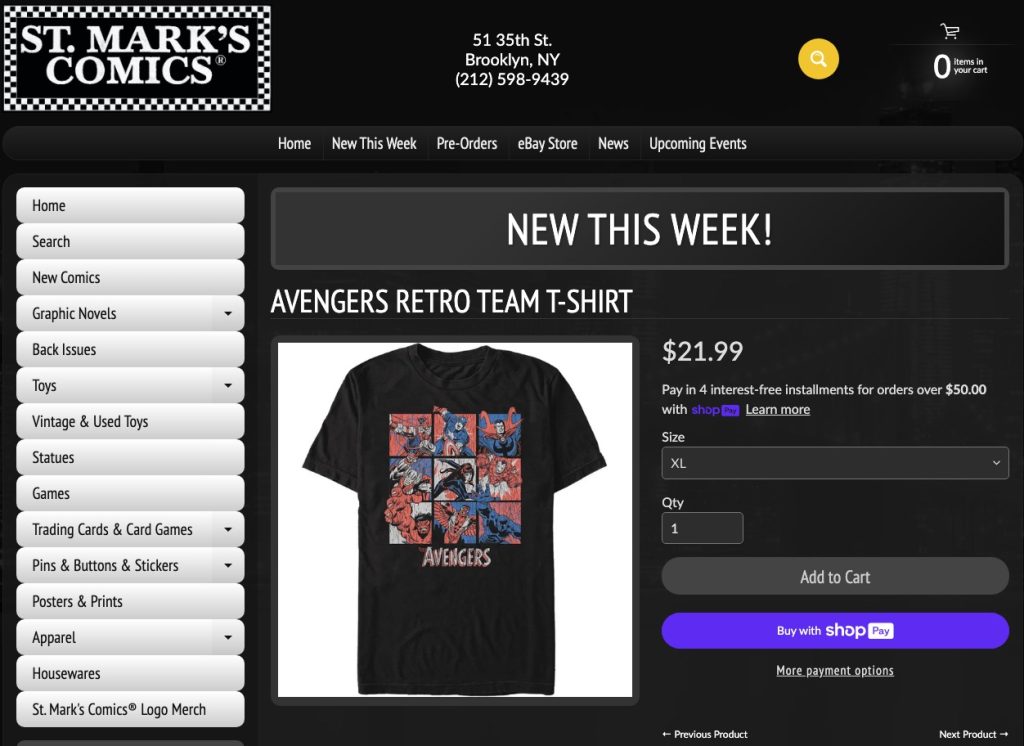
This specimen example is a screenshot of a listing on the online store of my client, St. Mark’s Comics, which is registered for retail store services for comic books and licensed merchandise, which includes apparel.
Like a screenshot specimen for goods, this example shows a functioning online ordering system for the goods described in the trademark application. Additionally, it shows that the applicant has their own online store on their own website, and it shows the trademark in the branding for the store, not the product listing. This makes it clear to the USPTO that the trademark identifies a retail store and not just a line of goods.
Photograph Specimens for Retail Store Services
As with other services, you can also submit a photograph of your brick-and-mortar retail store or kiosk if you have one, as long as you didn’t only specifically file for “online” retail store services. Photographs of your products themselves won’t count unless your store is clearly in the picture too.
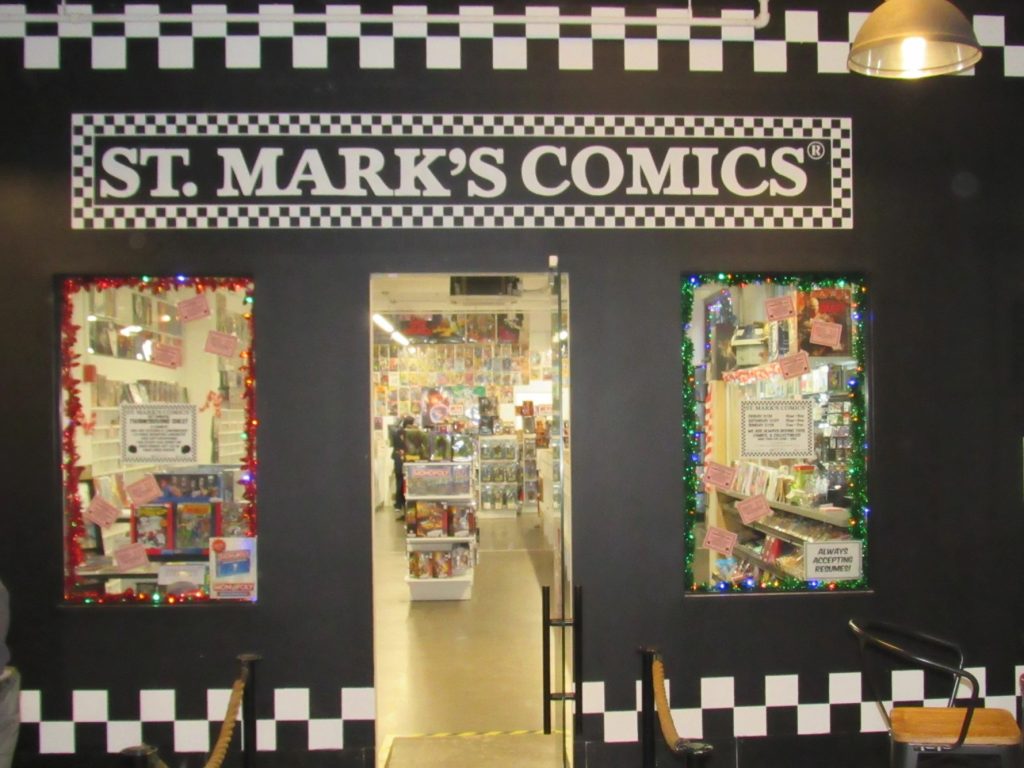
This photograph I grabbed from the St. Mark’s Comics website fits the bill. It shows my client’s storefront with the brand name on it and indications of the products sold. It’s easy here because the brand has the product described in the name itself, plus there are physical comics shown in the picture.
What Apparel Goods IDs to file for in Class 25 (You Can’t Just Put “Clothing”)
A lot of my clients, when they fill out our hiring form, just put “clothing” in the field where we ask what goods/services they want to register their trademark for. This is understandable, but it’s not an acceptable identification of goods on a U.S. trademark application.
So when a client tells us just to file for “clothing,” I have a list of goods identifications in class 25 that I ask the lawyers at my firm to file for, which I feel encompasses a broad enough array of clothing to cover any clothing company:
Class 25: Shirts; pants; tops as clothing; bottoms as clothing; clothing jackets; coats; suits; headwear; footwear; underwear; socks; dresses; skirts; leggings; swimwear; sleepwear; neckwear; clothing belts.
Note that accessories like bracelets and hair bows do not fit in this class. On a related note, “accessories” or “fashion accessories” is not an acceptable goods identification.
Yes, That Was a Lot
This post ended up being quite long at around 3,500 words. My post about software classes and specimens, which I consider to be pretty exhaustive, is 1,000 words shorter.
This isn’t a coincidence. Clothing trademark specimens are more difficult to do correctly than software trademark specimens, with more ways to “brick” your application by filing for the wrong goods or services.
If this is all too complicated for you, I don’t blame you. Fortunately, you can hire me to take over your application and fix it, or to do it correctly from the start.
Learn More About Our Trademark Registration Packages.
Follow Jeremy on Twitter.
Related Posts:
Client Spotlight: Argentina’s Football Trademarks for the World Cup
Stop Sending AI Workslop to Your Lawyer
Bad Brand Names
The 2025 USPTO Trademark Fee Increase: When Is It Happening?
Toy Trademarks: Dos and Don’ts for Toy Brand Protection
Can You Sell Patented Products on Amazon?
Trademarked Fruit Names: Sweet Sugar Mango’s Success
Forbes Names JPG Legal a Top Trademark Filing Service
Scalable Vs. Non-Scalable Business: A Comparison
USPTO ID.me Verification for Trademark Filings: What Is This?
Trademark Renewal Timeline: How Often Do You Have To Renew?
Client Spotlight: Juhn Hits 500 Million Streams for One Song
Software Trademark Guide: Classes and Specimens
Legal Mistakes Every Startup Company Should Avoid Making
An Affordable Trademark Attorney
Leveraging Social Media To Elevate Your Business Strategy
How To Attract More Customers to Your Business
Protecting Your Business 101: Lawsuits, Cybercrimes, and More
How To Reinvent and Reinvigorate Your Hiring Strategy
What a Startup Needs To Be Successful
Valuing a Trademark: How Much Is A Trademark Worth?
How to Come up with a Brand Name: A Lawyer’s Advice
Amazon Brand Registry Now Accepts Pending Trademark Applications
Our Law Firm’s Favorite Work-From-Home Gear
Recession Business Good, Sticky Business Better
Our March 2020 Weekly Revenue Numbers Show When Businesses Started Freaking out Around the World
March 2020 Update on JPG Legal
Trademarking a Band or Musician Name: Goods/Services IDs
Can Flavor Flav Sue The Sanders Campaign For Promoting a “Public Enemy” Performance?
New York’s New Broker Fee Rule: Can You Get Your Broker Fee Back?
Why We Raised Some of Our Fees
The New USPTO Rule: What Do Foreign Trademark Applicants Need to Do With Their Existing Trademarks?
How Early Should You Form Your LLC?
Amazon’s Project Zero Means Getting a Trademark Is Now More Important Than Ever
JPG Legal Update: New Attorney, New Space in Dumbo
JPG Legal Is Hiring Its First Associate Attorney
Mid-2018 Update on JPG Legal’s Growth
MoMA v. MoMaCha: a Trademark Attorney’s Perspective
MarkHound and the Move to Manhattan
The Evolution of JPG Legal as a Website and as a Law Firm
The Future of the Trademark Business Model
Trademark Websites Are Lying About the Amazon Brand Registry
Should I Trademark My Amazon Brand?
Are Negligence and Recklessness the Same Thing?
Can a Restraining Order Affect Your Security Clearance?
Can Filing a Restraining Order Against Somebody Affect Your Security Clearance?
Why Are Dead Presidents the Only Dead People with Trademark Protections?
